3D Pythagorean Calculator
3D Spatial Diagonal Formula
3D Distance = Square Root of (x² + y² + z²)
This equation extends the 2D Pythagorean theorem into three-dimensional space by executing two sequential right-angle steps:
- Calculate the 2D base diagonal:
p = √(x² + y²). - Calculate the 3D space diagonal using the base diagonal and the vertical dimension:
d = √(p² + z²) = √(x² + y² + z²).
Note: This direct formula applies strictly when all three components are mutually perpendicular.
What Is the 3D Pythagorean Theorem?
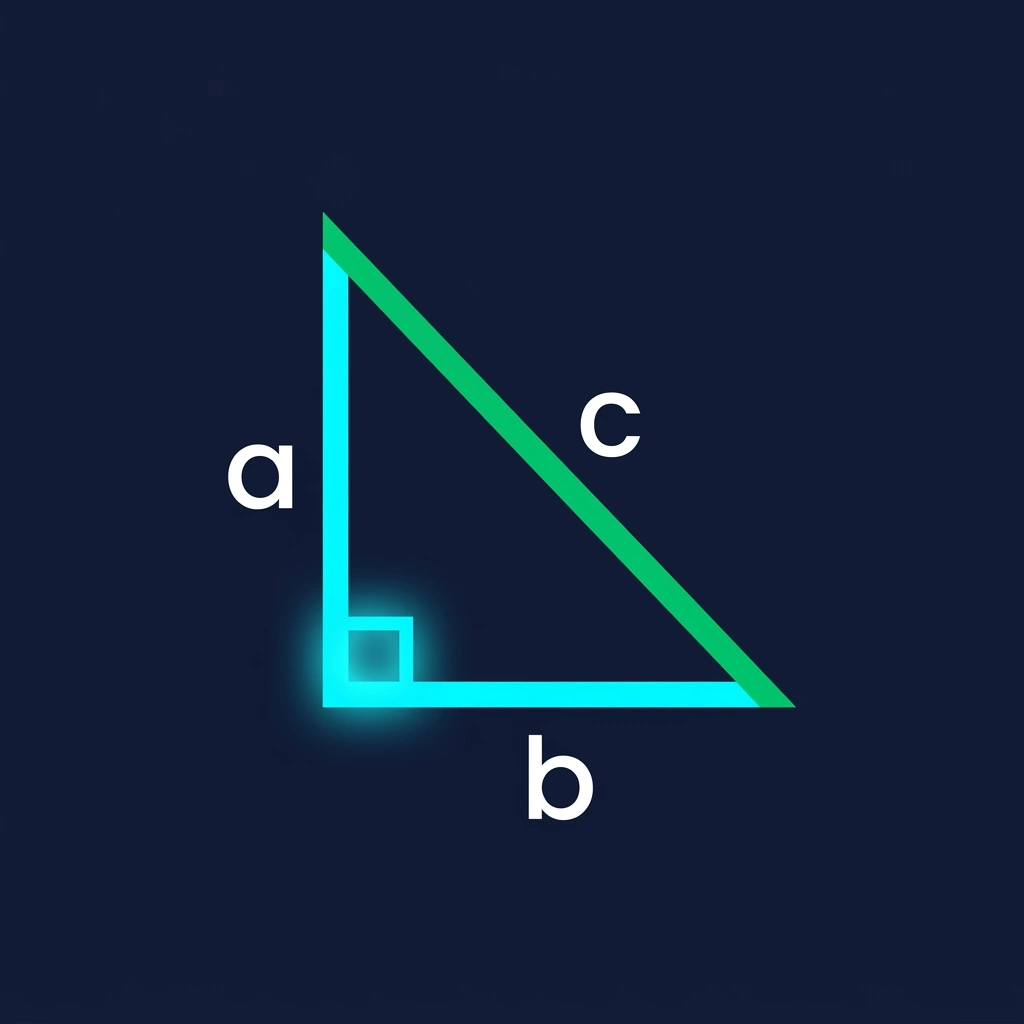
The 3D Pythagorean theorem is an extension of the classical two-dimensional Pythagorean formula into three-dimensional Euclidean space. While the 2D Pythagorean theorem calculates the hypotenuse c of a right-angled triangle across two perpendicular legs a and b using a² + b² = c², the 3D version accounts for a third mutually perpendicular dimension.
When three measurements—x, y, and z—meet at right angles to one another, the straight-line spatial distance d connecting opposite corners satisfies the relationship:
This equation computes the exact straight-line displacement through 3D space, serving as the foundation for spatial geometry, CAD modeling, structural engineering, and 3D coordinate vector calculations.
3D Pythagorean Theorem Formula
The central mathematical formula for three perpendicular dimensions is written as:
Where:
- x = First perpendicular component (e.g., length or horizontal displacement)
- y = Second perpendicular component (e.g., width or lateral displacement)
- z = Third perpendicular component (e.g., height or vertical displacement)
- d = Resulting 3D space diagonal or straight-line distance
All three components must be strictly perpendicular to each other (forming 90° angles between each axis) for this formula to yield mathematically correct results.
How the 3D Pythagorean Theorem Works
Understanding the 3D Pythagorean theorem requires breaking down a spatial calculation into two sequential 2D right triangle steps:
Stage 1 — 2D Base Diagonal
First, calculate the diagonal distance p across the two-dimensional base floor formed by components x and y:
Stage 2 — 3D Space Diagonal
Next, treat the base diagonal p and the vertical height z as legs of a second right triangle extending upward:
Because the square and square root operations cancel out on the base diagonal, combining the two steps yields the single direct 3D formula: d = √(x² + y² + z²).
How to Use the 3D Pythagorean Theorem Calculator
- Identify the three perpendicular dimensions of your object or spatial displacement.
- Determine the x value (first perpendicular dimension, such as length).
- Determine the y value (second perpendicular dimension, such as width).
- Determine the z value (third perpendicular dimension, such as height).
- Enter all three numerical values into their respective input fields.
- Confirm that all three dimensions are converted to compatible measurement units (e.g., all meters or all inches).
- Click Calculate 3D Distance.
- Review the computed 3D diagonal or distance output.
- Examine the step-by-step mathematical substitution breakdown provided below the result.
Understanding the Three Dimensions
In spatial geometry, the three variables represent orthogonal axes in Euclidean space:
| Variable | Geometric Meaning | Practical Box Example | Coordinate Example |
|---|---|---|---|
| x | First perpendicular dimension | Length (X-axis) | Δx = x₂ - x₁ |
| y | Second perpendicular dimension | Width (Y-axis) | Δy = y₂ - y₁ |
| z | Third perpendicular dimension | Height (Z-axis) | Δz = z₂ - z₁ |
| d | Resulting 3D diagonal/distance | Corner-to-opposite-corner space diagonal | Straight-line 3D distance |
3D Diagonal Calculation Example
Consider a room or shipping container with perpendicular dimensions x = 3 units, y = 4 units, and z = 12 units.
Calculate the corner-to-opposite-corner diagonal distance:
The straight-line distance across the 3D space is exactly 13 units.
3D Pythagorean Theorem Worked Calculation
When dimensions do not form perfect integer square roots, the 3D formula provides an accurate decimal approximation. Suppose x = 5, y = 6, and z = 7:
Step-by-step substitution:
Retaining decimal precision ensures exact engineering layout alignment.
3D Diagonal of a Rectangular Box
For any rectangular box, cuboid, or rectangular prism, the 3D space diagonal represents the longest possible straight line between two opposing corners inside the object:
Worked Example: Find the diagonal of a box with Length = 10 cm, Width = 6 cm, and Height = 4 cm:
This calculation tells you the maximum length of a rigid rod or pole that can fit inside the box.
3D Distance Between Two Points
The 3D Pythagorean theorem also powers the 3D distance formula between two points in Cartesian coordinate space: P₁(x₁, y₁, z₁) and P₂(x₂, y₂, z₂):
Example: Calculate distance between P₁(1, 2, 3) and P₂(4, 6, 15):
- Δx = 4 - 1 = 3
- Δy = 6 - 2 = 4
- Δz = 15 - 3 = 12
Note: If your inputs are component displacement distances Δx, Δy, and Δz, enter them directly into our 3D calculator as x, y, and z.
3D Pythagorean Theorem vs. 2D Pythagorean Theorem
Comparing the 2D and 3D formulations highlights how the relationship expands across dimensions:
| Feature | 2D Pythagorean Theorem | 3D Pythagorean Theorem |
|---|---|---|
| Formula | c = √(a² + b²) |
d = √(x² + y² + z²) |
| Components | 2 perpendicular legs (a, b) | 3 perpendicular axes (x, y, z) |
| Application | Flat right triangles | Cuboids, room diagonals, 3D vectors |
| Result Type | Hypotenuse (c) | Spatial diagonal or distance (d) |
To solve standard flat right triangles, visit our dedicated Pythagorean Theorem Calculator.
3D Distance vs. 3D Diagonal
Although both terms are used interchangeably in geometry, they apply to slightly different physical contexts:
- 3D Diagonal: Typically refers to the physical straight line spanning opposite vertices across a 3D solid object, such as a box, cuboid, or rectangular room.
- 3D Distance: Refers to the straight-line Euclidean distance separation between two arbitrary point coordinates in 3D coordinate space.
Mathematically, whenever the underlying axes or components are mutually perpendicular, both calculations rely on the exact same formula: √(x² + y² + z²).
When Can You Use the 3D Pythagorean Theorem?
To ensure mathematical accuracy, verify that your problem meets the following mandatory criteria:
- Mutual Perpendicularity: All three dimensions must meet at 90° right angles to one another.
- Compatible Units: All three input values must be converted to the same unit of measure before squaring.
- Independent Dimensions: Each component must measure displacement along an independent orthogonal axis (X, Y, and Z).
- Euclidean Geometry: Calculations assume flat, three-dimensional Euclidean space.
3D Pythagorean Theorem With Different Units
Always ensure unit uniformity prior to calculation. For example:
3 m, 4 m, 12 m⟹d = 13 m30 cm, 40 cm, 120 cm⟹d = 130 cm
If measurements are given in mixed units (e.g., 2 meters, 150 centimeters, and 50 millimeters), convert all values to meters first before running the formula.
3D Pythagorean Theorem With Decimal Values
The formula handles non-integer and decimal dimensions seamlessly:
Example: x = 2.5, y = 4.2, z = 6.1
Common 3D Pythagorean Theorem Mistakes
- Using the 2D formula for a 3D problem: Omitting the third dimension
zproduces an incomplete base calculation instead of the true 3D spatial diagonal. - Forgetting the third dimension: Ensure all three axes (length, width, height) are included in the sum.
- Adding dimensions before squaring: Calculating
(x + y + z)²is incorrect. You must square each component individually first:x² + y² + z². - Forgetting the square root: Leaving the answer as
x² + y² + z²gives the squared distanced², not the final linear distanced. - Mixing units: Inputting inches for
xand feet foryleads to erroneous results. - Using non-perpendicular components: Applying the formula to non-right-angled boxes or oblique parallelepipeds causes geometric errors.
- Rounding intermediate values too early: Rounding squared components prematurely degrades final precision.
- Confusing the 3D diagonal with total linear dimensions: The 3D diagonal is strictly smaller than the simple sum of the sides:
d < x + y + z. - Entering invalid or negative dimensions: Geometric lengths and physical distances must be positive real numbers.
3D Pythagorean Theorem Input Requirements
To use this 3D calculator effectively, inputs must satisfy the following conditions:
- Exactly three numerical dimensions (
x,y,z) must be provided. - Inputs must be positive real numbers greater than zero.
- Inputs must share identical measurement units.
- Inputs must correspond to mutually perpendicular axes.
3D Pythagorean Theorem Accuracy and Rounding
Many 3D diagonal calculations result in irrational square roots. For instance, dimensions of 5, 6, and 7 yield √110 ≈ 10.4881. Our calculator maintains full floating-point precision throughout intermediate steps and rounds display values to 4 decimal places for optimal clarity and practical engineering use.
Practical Applications of 3D Pythagorean Calculations
- Architecture & Construction: Calculating maximum room diagonals, ceiling-to-corner timber bracing, and HVAC ducting runs.
- Logistics & Freight: Verifying whether long pipes, poles, or carpet rolls can fit diagonally inside cargo boxes or shipping containers.
- CAD & 3D Modeling: Computing vector magnitudes, mesh node distances, and 3D camera placements in a Cartesian coordinate system.
- Physics & Robotics: Determining spatial displacement vectors, end-effector positions, and 3D velocity magnitudes.
- Surveying & Mapping: Finding 3D spatial distances between GPS elevation points.
3D Pythagorean Theorem FAQ
The 3D Pythagorean theorem is a spatial extension of the 2D theorem used to calculate the diagonal or straight-line distance across three mutually perpendicular dimensions using d = √(x² + y² + z²).
The formula for a 3D diagonal is d = √(x² + y² + z²), where x, y, and z represent the three perpendicular dimensions.
Square each of the three perpendicular dimensions (x², y², z²), add the three squared values together, and calculate the square root of the sum.
In 3D Pythagorean calculations, x, y, and z represent three mutually perpendicular side lengths or spatial displacement components, such as length, width, and height.
Yes. Entering the length, width, and height of a rectangular box or cuboid into the 3D calculator yields the straight-line corner-to-opposite-corner space diagonal.
Yes. By determining the perpendicular coordinate differences Δx = x₂ - x₁, Δy = y₂ - y₁, and Δz = z₂ - z₁, the distance is computed as d = √[(Δx)² + (Δy)² + (Δz)²].
Yes. The direct formula d = √(x² + y² + z²) strictly requires all three components to meet at 90-degree right angles relative to each other.
Yes. The calculator fully accepts positive decimal values and fractional inputs for x, y, and z.
You can select units such as cm, m, mm, in, ft, or yd. All input values should be converted to compatible units prior to calculation.
The 2D Pythagorean theorem computes a hypotenuse across two perpendicular legs using c = √(a² + b²), while the 3D theorem extends this to three perpendicular dimensions using d = √(x² + y² + z²).