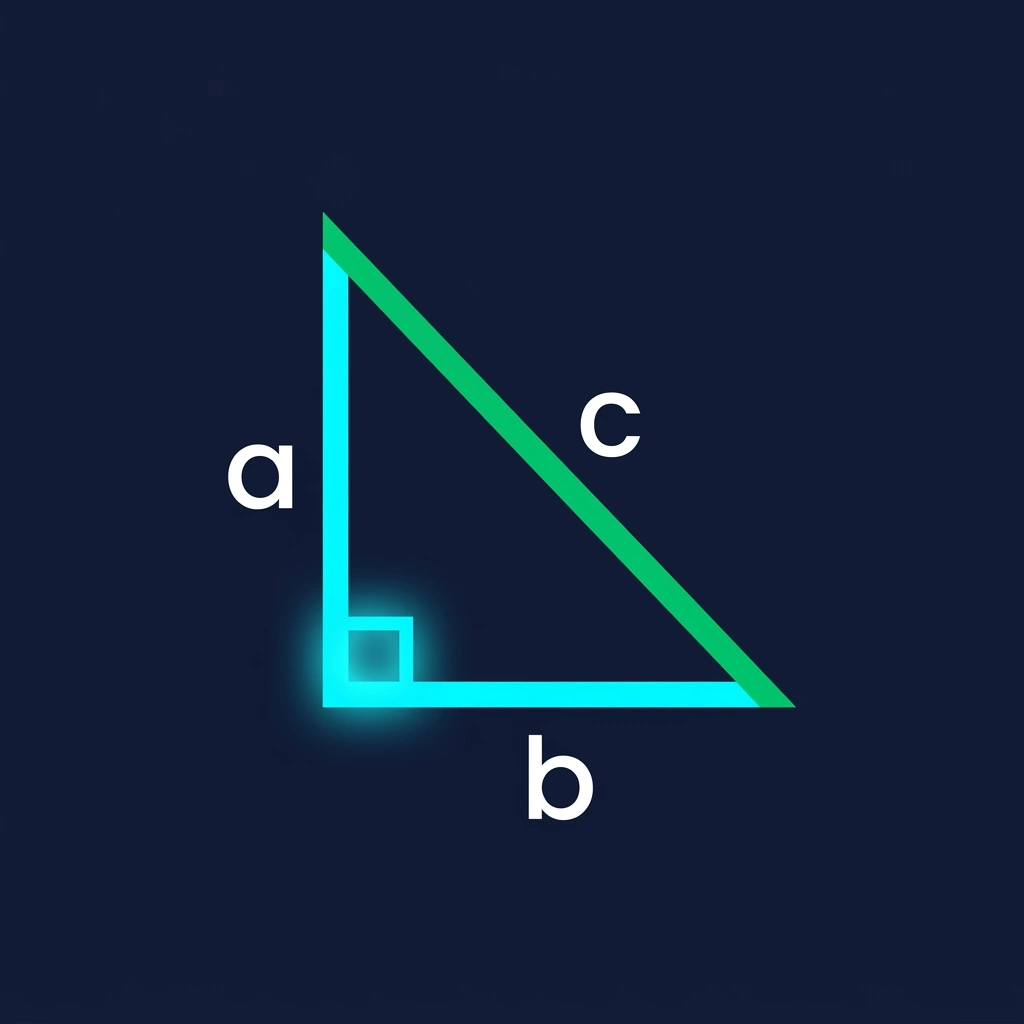
The Pythagorean theorem calculator finds an unknown side of a right triangle when the required side lengths are known using the fundamental geometric equation a² + b² = c².
Calculate the hypotenuse or a missing leg instantly when the required side lengths are known with step-by-step mathematical substitution, visual SVG diagrams, and unit conversions.
Right TriangleHypotenuseMissing Sidea² + b² = c²Pythagorean Theorem
The Pythagorean theorem describes the fundamental geometric relationship between the three sides of a right triangle. It states that the square of the hypotenuse is equal to the sum of the squares of the two legs:
a² + b² = c²
Where a and b are the leg lengths, and c is the hypotenuse.
a — One leg forming the 90° right angle.
b — The second leg forming the 90° right angle.
c — The hypotenuse opposite the 90° right angle.
The theorem applies specifically to right triangles.
Understanding the Sides of a Right Triangle
A right triangle consists of three distinct sides defined relative to the 90-degree right angle:
Leg a
One of the two perpendicular sides forming the right angle.
Leg b
The second perpendicular side forming the right angle.
Hypotenuse c
The side opposite the 90° angle and the longest side of the right triangle.
Right Triangle Architecture
Leg a ⊥ Leg b | Hypotenuse c = Longest Side (Opposite 90° Angle)
When Does the Pythagorean Theorem Apply?
To use the Pythagorean equation accurately, ensure your geometric problem satisfies these requirements:
The triangle must be a right triangle.
One angle must measure exactly 90°.
The hypotenuse is opposite the right angle.
The two other sides are the legs.
Measurements should use compatible units.
Note: The standard Pythagorean theorem should not be applied directly to arbitrary non-right triangles. For acute or obtuse triangles, use the Law of Cosines.
How to Use the Pythagorean Theorem Calculator
Follow these quick steps to calculate any unknown right triangle side length:
1
Identify the 90° angle.
2
Identify the hypotenuse.
3
Enter the two known side lengths.
4
Select the unknown side.
5
Select the appropriate unit.
6
Click Calculate.
7
Review the formula and calculation steps.
Pythagorean Theorem Example
Classic 3-4-5 Triangle
Here is a step-by-step calculation for a right triangle with leg lengths a = 3 and b = 4:
Given: a = 3, b = 4
Formula: c = √(a² + b²)
Substitution: c = √(3² + 4²)
Calculation: c = √(9 + 16) = √25 = 5
Conclusion: The hypotenuse is 5 units.
How to Check a Right Triangle
If three side lengths are known, identify the longest side as c and check whether they satisfy the Pythagorean relationship:
a² + b² = c²
Example: Test side lengths 7, 24, and 25:
7² + 24² = 25²
49 + 576 = 625
625 = 625
Therefore, the relationship is satisfied and the triangle contains a 90° right angle.
Keep these practical guidelines in mind when inputting measurements into the calculator:
Enter positive numbers greater than zero.
Use compatible units for all inputs (e.g., all centimeters or all feet).
Identify the hypotenuse correctly as the side opposite the 90° angle.
The hypotenuse must be longer than either leg.
The standard theorem requires a right triangle.
Decimal values can be used if supported by the calculator.
Common Pythagorean Theorem Mistakes
Avoid these frequent pitfalls when solving right triangle side lengths:
Using the wrong hypotenuse
The hypotenuse is opposite the 90° angle. Never substitute a leg length in place of side c.
Forgetting to square the sides
Use a² and b², not a + b. The sum of leg lengths is always strictly greater than hypotenuse c.
Using the theorem on a non-right triangle
The standard equation applies strictly to right triangles. Use the Law of Cosines for acute/obtuse triangles.
Mixing units
Convert measurements to compatible units (e.g., converting inches to feet) before calculating.
Entering an impossible combination
The hypotenuse must be longer than either leg. The calculator requires c > a and c > b.
Pythagorean Theorem Terms
Core mathematical vocabulary associated with right-triangle side calculations:
Pythagorean theorem
The geometric theorem stating that in a right triangle, the square of the hypotenuse equals the sum of the squares of the legs (a² + b² = c²).
Right triangle
A three-sided geometric figure containing one interior angle measuring exactly 90 degrees.
Hypotenuse
The hypotenuse is the side opposite the 90-degree right angle and always the longest side of a right triangle.
Leg
Either of the two shorter sides of a right triangle adjacent to the 90° right angle.
Right angle
A 90-degree angle formed by two perpendicular lines or sides.
Missing side
An unknown leg or hypotenuse length computed using two known side measurements.
Pythagorean triple
A set of three positive integers (a, b, c) that satisfy the equation a² + b² = c².
3-4-5 triangle
The simplest integer right triangle with leg lengths 3 and 4, and hypotenuse 5.
Converse
The geometric rule stating that if three side lengths satisfy a² + b² = c², the triangle must be a right triangle.
Diagonal
A straight line segment connecting non-adjacent corners of a polygon or 3D box.
Pythagorean Theorem Calculator FAQ
The Pythagorean theorem calculator finds an unknown side length (hypotenuse or missing leg) of a right triangle when two required side lengths are known.
Yes, select "Find Hypotenuse (c)", enter legs a and b, and the calculator computes c = √(a² + b²).
Yes, select "Find Side (a)" or "Find Side (b)", input hypotenuse c and the known leg, and the calculator computes the missing leg using a = √(c² - b²).
No. The standard Pythagorean theorem applies strictly to right triangles containing a 90° angle. Non-right triangles require the Law of Cosines.
The hypotenuse (c) is the side opposite the 90° right angle and is always the longest side of a right-angled triangle.
Yes, our calculator supports all positive decimal values and fractional inputs.
You can select units such as centimeters (cm), meters (m), millimeters (mm), inches (in), feet (ft), or yards (yd).
The calculator displays an error message if the hypotenuse is less than or equal to a leg, as a right triangle cannot be formed.
Reverse calculation rearranges the formula to solve for an unknown leg, while the converse tests whether three given side lengths satisfy a² + b² = c² to form a right angle.
A Pythagorean triple consists of three positive integers (a, b, c) that satisfy the equation a² + b² = c², such as (3, 4, 5).
Related Pythagorean Theorem Calculators
Explore specialized right triangle tools tailored to your exact mathematical or engineering requirements: